
Weak Water Upstairs Since Your New Combi Boiler?
By Emergency Plumb,
New boiler, more space in the airing cupboard, loft tank gone, no more waiting for the cylinder to heat. Lovely. Except the shower upstairs now feels like standing under a watering can, and the bathroom basin takes forever to fill. Downstairs seems fine. You’ve spent good money, so it’s natural to wonder if you’ve been sold a dud. Usually you haven’t. The house is just being asked to do something it wasn’t built for.
Short answer: When upstairs water goes weak after a gravity system is swapped for a combi, it’s because every tap now runs off the mains. That water has to climb a floor, share one incoming pipe and pass through the combi’s heat exchanger, so upstairs outlets feel it most. Check the stopcock and any new valves are fully open, clean the combi’s inlet filter and shower head, then time a bucket upstairs and downstairs. If the incoming supply is the limit, the fix is usually a bigger supply pipe or better pipework, not a new boiler.
What changed when the tank came out?
In a typical older London house with a loft tank, the kitchen cold tap came off the mains, but the bathroom upstairs was fed from the tank above it through wide pipes. The tank gave a steady supply, and if the shower had a pump, that did the heavy lifting.
With a combi, all of that goes. Everything, hot and cold, upstairs and down, now hangs off one pipe from the street. Three things work against the top floor:
- Height. Water loses some pressure for every metre it climbs. The higher the bathroom, the less is left by the time it gets there. Water companies plan for this too: SES Water’s guidance on flats notes that some developments need a tank and booster set so that higher floors keep enough pressure.
- Sharing. Downstairs taps sit closer to the stopcock, so when two outlets are open, they tend to win.
- The boiler itself. Heat Geek explains that a combi’s hot side is more restrictive than the cold, because the water has to pass through a plate heat exchanger and flow restrictors. So upstairs hot usually suffers more than upstairs cold.
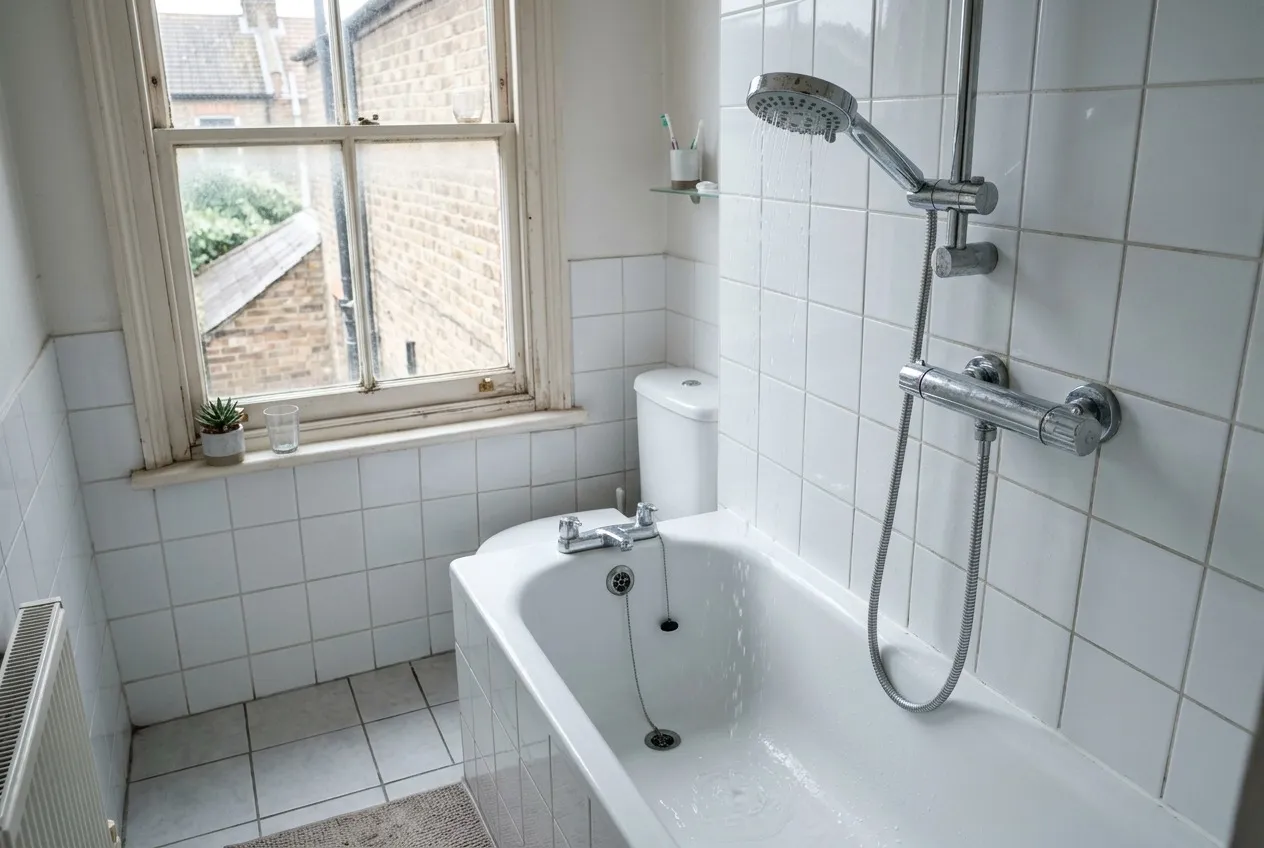
Illustration made with AI to show a weak shower in an upstairs bathroom. It is not a photo of one of our jobs.
What can I check before calling anyone?
- Stopcock fully open. Gently anticlockwise until it stops. Installers often turn the water off to fit a combi, and a valve left half open is a common, easy win.
- Any new isolation valves. Look on the pipes under the boiler. A small slotted valve that’s only part open will throttle the whole house.
- Shower head and aerators. Grit gets stirred up when water is drained and refilled. Unscrew and rinse them.
- Time it upstairs and downstairs. Fill a measured bucket from the kitchen cold tap, then from the bath cold upstairs. Work out litres per minute for each and write it down.
- Upstairs hot on its own. Run it with nothing else open. If it’s strong alone but dies when someone uses the kitchen, the incoming supply is stretched thin.
If the kitchen cold tap is weak too, the problem is the whole supply rather than the stairs. Our guide to low water pressure in the house covers that, and if a water meter was fitted around the same time, read low water pressure after a water meter was installed.
What it usually is
| What you notice | Usual cause |
|---|---|
| Everything weak since install day | Stopcock or new valve left part closed |
| Upstairs hot poor, upstairs cold fine | Combi inlet filter, scale or its flow settings |
| Upstairs hot and cold both weak | Incoming supply or pipe size can’t feed the top floor |
| Fine alone, dies when another tap opens | Shared supply too small for two outlets |
| Hot cuts out completely with a second tap | Flow dropping under the combi’s minimum |
That last one has its own guide: combi cutting out when another tap is turned on.
How do we fix it?
We start by measuring the flow at the stopcock, at the boiler and at the top-floor outlets, so we know where it’s being lost. Then it’s usually one of these:
- Open, clean, rebalance. Valves, filters and a greedy downstairs outlet. Cheap, and sometimes it’s all you need.
- Bigger pipework to the bathroom. If a thin pipe was teed in to reach the old upstairs fittings, pipework replacement with a properly sized run often makes a big difference.
- A better supply from the street. In plenty of London terraces the incoming pipe is old and narrow, sometimes lead. Lead pipe replacement gives the combi more to work with.
- A different hot water set-up. If the household regularly runs two showers at once, a combi may simply be the wrong fit. A mains-pressure unvented cylinder stores hot water so several outlets can run together.
We charge by the hour with no call-out fee: £110 for the first hour, £45 for each half hour after that, plus parts. The detail is on our prices page.
No water upstairs at all?
If it’s gone from weak to nothing, or a pipe has started leaking since the work, don’t sit on it. Our 24-hour emergency plumbers cover London and the M25 towns and usually get to you in 60 minutes. You can see the rest of what we do on our emergency plumber in London page, or call or WhatsApp 07861 933265 with what’s happening upstairs.
Questions people ask
Why is my upstairs water weaker since the combi went in?
Before, the upstairs taps and shower were probably fed from a tank in the loft through fairly wide pipes, sometimes with a pump on the shower. Now everything runs off the mains through the combi. That water has to climb to the first floor, share the incoming pipe with every other outlet, and squeeze through the boiler's heat exchanger, so upstairs is where you feel the squeeze first.
Was the combi fitted wrongly?
Not necessarily. A combi can only give what the incoming supply gives it. Sometimes a valve has been left part closed or a filter is blocked after the install, and that's quick to fix. More often the house's supply pipe or internal pipework was never sized for everything to run off the mains.
Is the cold upstairs weak too, or just the hot?
It's worth checking both. If upstairs cold is fine and only the hot is poor, look at the combi itself, its filter and its flow settings. If upstairs hot and cold are both weak, the limit is the water coming into the house or the pipes carrying it upstairs.
Can I keep my old shower pump?
No. A shower pump from a tank-fed system was built to draw from the loft tank, and once that's gone there's nothing for it to work with. The answer is to improve the supply or the pipework, or in some homes to choose a different hot water set-up.
How much will it cost to find out?
No call-out charge. It's £110 for the first hour and £45 for each half hour after, plus parts, and the rate is the same at night and at weekends.