
Lead Pipes in London Homes: How to Spot and Replace Them
By Emergency Plumb,
You’re under the kitchen sink looking for the stopcock, torch in your teeth, and you notice the pipe coming up through the floorboards looks nothing like the copper around it. It’s dull grey, a bit lumpy, with a big swollen knot of a joint. There’s a fair chance you’ve just met your lead supply pipe. Loads of London homes still have one, and it’s nothing to panic about tonight, but it is worth sorting.
Short answer: If your home was built before 1970, it may still be fed by a lead pipe. Lead pipe is dull grey, soft, has rounded bulging joints and shows shiny silver when scratched. Thames Water owns the pipe up to the outside stop valve near your boundary; the supply pipe into your home and everything inside is yours. Until it’s replaced, run the cold kitchen tap for a couple of minutes before drinking. Replacement means swapping your length for modern plastic pipe and asking Thames Water to change its side.
Why do so many London homes still have lead?
Lead was used for water pipes for generations because it was easy to bend and joint. Thames Water’s water quality advice is simple: you may have lead pipes if your property was built before 1970. In London that takes in miles of Victorian terraces in places like Walthamstow and Brixton, Edwardian semis across the suburbs, and plenty of older mansion blocks and conversions.
It’s a big job for the water company too. Thames Water has given the Drinking Water Inspectorate a formal undertaking that includes a target of 54,000 lead communication pipe replacements by March 2030. That tells you how many are still in the ground.
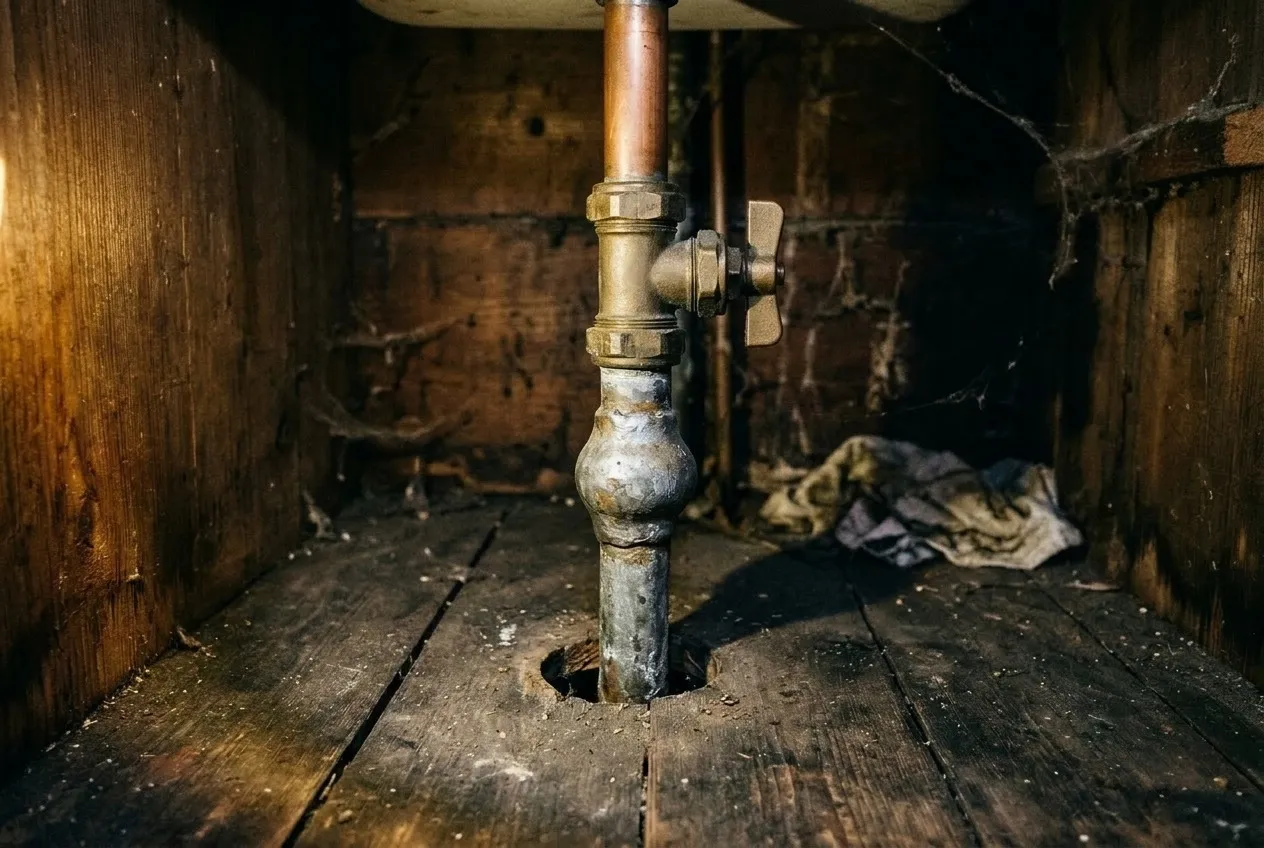
Illustration made with AI to show what a lead supply pipe can look like under a sink. It is not a photo of one of our jobs.
How to check your own pipes
- Find the internal stopcock. Under the kitchen sink is most common, then under the stairs, in a cellar, or in a cupboard by the front door. Our guide to a stiff or seized stopcock is handy if yours hasn’t moved in years.
- Look at the pipe below the stopcock, where it comes up from the floor. That’s the end of your supply pipe from the street.
- Check the colour and joints. Lead is matt grey with smooth, swollen joints that look moulded on. Copper is reddish-brown with neat compression or soldered fittings. Blue or black plastic means it’s already been replaced.
- Scratch it gently with a coin. Lead is soft and shows bright silver under the grey. Galvanised steel doesn’t scratch like that.
- Try a fridge magnet. It won’t stick to lead or copper, but it will stick to old iron or steel pipe.
- Check the rest of the house. Some older homes have short lead sections inside, round the old cold tank or near the kitchen tap, even where the supply pipe has been changed.
Which part is yours, and what will Thames Water do?
This trips a lot of people up. Thames Water says it owns the communication pipe, which starts at its water main and usually runs to the outside stop valve at your property boundary. It’s responsible for fixing or replacing that part. The supply pipe from the outside stop valve into your home is yours, the internal pipework is yours, and a supply pipe shared with neighbours is the joint responsibility of everyone on it.
Thames Water also runs a lead pipe replacement scheme for its side. When we checked in November 2026, its page said the scheme was closed and would reopen in spring 2027. Its listed conditions included a home built before 1970, a plan to replace your own lead pipework within three months, and evidence from an approved plumber that your side has been done, so read the page carefully before you book anything.
Our low water pressure guide explains why an old, narrow lead supply often goes hand in hand with a weak flow upstairs.
What does replacing a lead pipe involve?
| Stage | What happens |
|---|---|
| Check | We confirm the supply is lead and trace where it runs from the outside stop valve to your stopcock |
| New pipe in | Modern plastic supply pipe is laid, often pulled through underground with a mole rather than digging a long trench |
| New stopcock | A fresh stopcock goes on where the pipe enters the house, so you can shut the water off easily |
| Inside sections | Any lead left inside, like a short run to the kitchen tap, is cut out and replaced |
| Earth check | Older homes sometimes used the metal water pipe as an electrical earth. Thames Water flags an earthing check for houses built before 1966, so get an electrician to confirm the earth is sound once plastic goes in |
| Water company side | You ask Thames Water to replace its communication pipe so the whole run is lead-free |
Thames Water says that after the work is finished you should run all taps used for drinking or cooking for 10 minutes to flush the new pipe through.
Have a look at our lead pipe replacement page for how we run the job. We work by the hour, with no call-out charge: £110 for the first hour, then £45 per half hour, plus materials. The full breakdown is on our prices page.
Old lead pipe split or leaking?
Old lead can split, especially after a hard frost. If water’s coming up through a floor or the stopcock won’t shut, our 24-hour emergency plumbers can get to most of London and the M25 towns in about 60 minutes. Call or WhatsApp 07861 933265, or find out what else our emergency plumber in London team does.
Questions people ask
How do I know if my house has lead pipes?
Find your internal stopcock, usually under the kitchen sink, and look at the pipe coming up through the floor below it. Lead is dull grey, soft, has fat rounded joints rather than neat fittings, and a gentle scratch with a coin shows bright silver underneath. It doesn't attract a magnet. Copper is orange-brown, and modern plastic supply pipe is usually blue.
Which homes in London are likely to have lead pipes?
Thames Water says you may have lead pipes if your property was built before 1970. That covers most Victorian and Edwardian terraces, interwar semis and a lot of older purpose-built flats. Some will have been replaced over the years, so the only way to know is to look.
Who pays to replace a lead supply pipe?
Thames Water owns the communication pipe, which runs from its main to the outside stop valve, usually near your boundary. The supply pipe from there into your home, and the pipes inside, are yours, and a shared supply pipe is the joint responsibility of the households on it. You arrange and pay for your part; Thames Water deals with its part.
Is it safe to drink the water while I wait?
Thames Water's advice, until lead pipes are replaced, is to flush the cold kitchen tap for about two minutes before you use it. It's a sensible habit to drink and cook from that cold tap rather than the hot.
How much does lead pipe replacement cost with you?
We don't give fixed quotes. Lead replacement is charged at our normal rate: £110 for the first hour, £45 for each half hour after, plus pipe and fittings, and no call-out charge. How long it takes depends on the length of the run and whether the pipe can be pulled through underground.
Sources
- Lead pipe replacement, Thames Water
- Water quality: help and advice, Thames Water
- Thames Water Utilities Limited: AMP8 lead strategy, Drinking Water Inspectorate