
Pipes Banging Since Your Water Meter Was Fitted?
By Emergency Plumb,
The water company’s been, there’s a shiny new cover in the pavement, and now every time the washing machine fills or someone turns a tap off, the pipes go off like a builder’s van over a speed bump. You’re not imagining the link. A new meter doesn’t usually break anything, but the work around it can change how your plumbing behaves.
Short answer: After a meter is fitted, banging usually comes from one of three things: air left in the pipes after the water was turned off and on, a stopcock or valve left part-closed, or water hammer that the new fittings have made more noticeable. Run every tap to clear air, check your inside stopcock is fully open, and listen for when the bang happens. If it’s a sharp knock as a valve shuts, or it carries on after a few days, get the pipework checked.
Why the meter visit can set it off
Thames Water says it will always aim to fit your meter outside, in the pavement, and that it may need to turn your water off for a few minutes to do it, whether the meter goes outside or inside. That’s normal. But turning a supply off and on can:
- Let air in. When the water comes back, pockets of air get pushed through the pipes. That sounds like spluttering taps, chugging and knocking until it clears.
- Shift debris. Old scale and sediment can get stirred up and lodge in a tap, a valve or a shower mixer, which can then rattle or hum.
- Change the way your pipes take a shock. When a tap or appliance valve shuts suddenly, the moving water has to stop dead, and that shock is water hammer. Some supply arrangements include a check valve so water can’t flow back into the main; Water Regs UK notes that water displaced by expansion mustn’t flow back into the water company’s pipework. If water in your system can no longer ease backwards, a shock that used to fade away can bang instead.
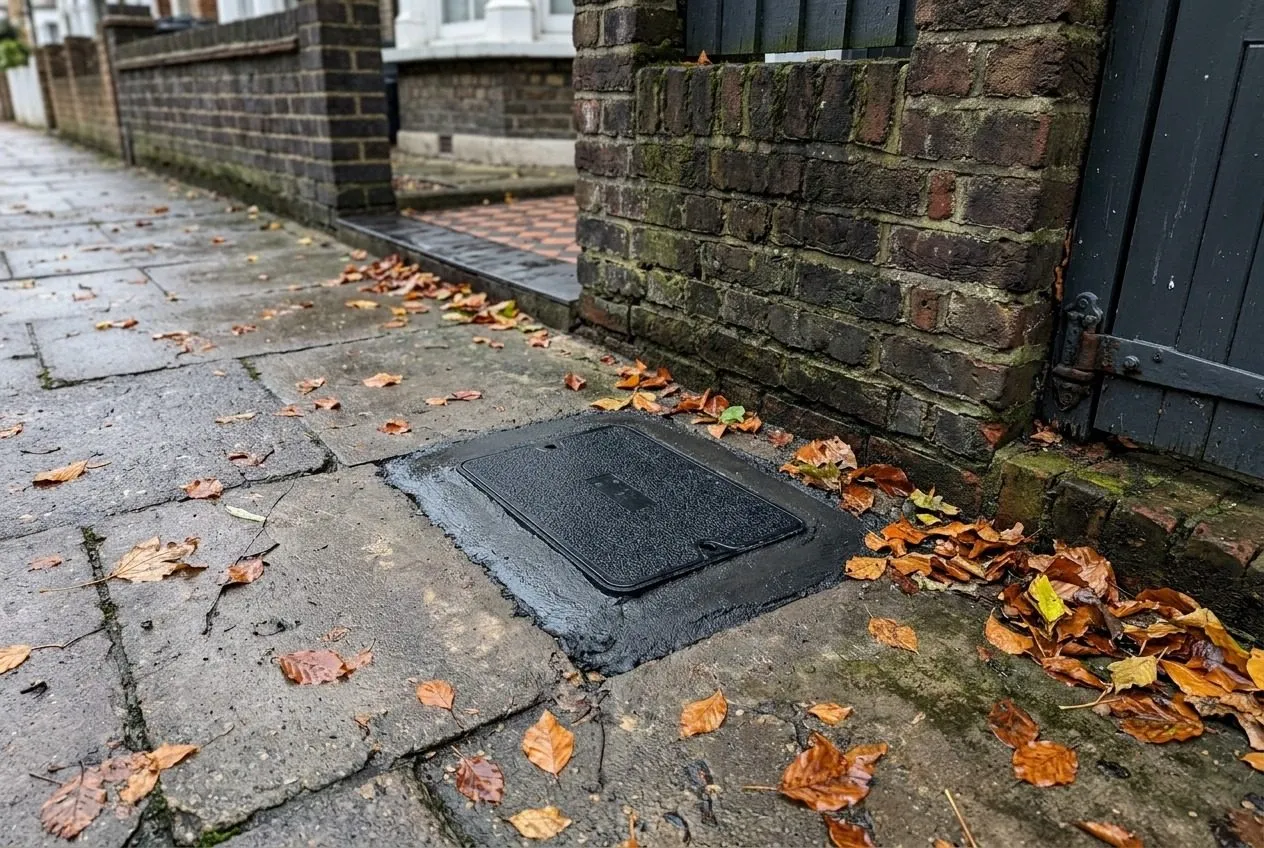
Illustration made with AI to show a freshly fitted pavement meter cover. It is not a photo of a real installation or of our work.
What you can check yourself
- Bleed the air out. Open every tap in the house, cold first and then hot, one at a time from the lowest to the highest. Let each run until the flow is smooth, then close them in reverse order.
- Check your inside stopcock. It’s usually under the kitchen sink. Make sure it’s fully open. A part-closed stopcock can hum or whistle and starve the house of flow. If it’s stiff or won’t turn, don’t force it: our guide to a seized or stuck stopcock explains why.
- Pin down when it bangs. Write it down for a day. Only when the washing machine or dishwasher stops filling? Only after a hot shower? Only at night? The pattern points at the cause.
- Do a quick leak check. With everything off, look at the meter or the reading on your account. If it keeps moving, water is going somewhere, and that’s now coming out of your pocket.
Reading the noise
| When it bangs | Likely cause |
|---|---|
| Spluttering taps, knocking that eases over a day or two | Air in the pipes after the water was off |
| A single hard bang when a washing machine or dishwasher stops filling | Water hammer from a fast-shutting appliance valve |
| Knocking after heavy hot water use, from a combi or water heater | Expansion with nowhere to go, worth checking any expansion vessel |
| Humming or whistling all the time | Valve part-closed, worn washer, or high incoming pressure |
There’s more on all of these in our guide to what causes noisy water pipes.
Who to call: water company or plumber?
If water is leaking around the meter itself, the cover is damaged, or you think something was fitted wrong, that’s for the water company: contact Thames Water and tell them when the meter went in. The pipework inside your home is yours, and that’s where we come in.
How we fix it
We start by listening, honestly. We’ll run the appliances, open and shut taps, and trace where the bang comes from. Then it’s usually one of these: clearing air and flushing out debris, opening or replacing a tired stopcock, clipping loose pipe runs so they can’t slam against joists, fitting a water hammer arrestor near a noisy appliance, or checking pressure and any expansion arrangement on a combi or water heater. If old pipework is the weak spot, we’ll talk you through pipework replacement.
Same price whenever you call: no call-out fee, £110 for the first hour, £45 per half hour after, plus parts. See the prices page.
And if the banging ends with a joint giving way and water where it shouldn’t be, don’t wait. Turn the stopcock off and call or WhatsApp 07861 933265. Our emergency plumbers in London are on 24/7 and usually with you in 60 minutes.
Questions people ask
Can fitting a water meter really make my pipes bang?
It can set it off, yes. Fitting a meter usually means the water is turned off for a while and back on again, which can leave air in the pipes and stir things up. Any change to the supply fittings can also change how the water in your pipes behaves when a tap or appliance snaps shut. The meter itself isn't usually broken.
Is the water company responsible for fixing it?
Thames Water looks after the supply up to the boundary and its own meter and fittings. The pipework inside your property is yours. If you think the meter installation itself is faulty, leaking or fitted wrong, report it to them. If the banging is coming from your own pipes, a plumber sorts that.
Is banging dangerous or just annoying?
Air spluttering usually settles. Proper water hammer, a hard bang when a tap or washing machine valve shuts, is worth fixing because repeated shocks can loosen joints over time. If you also see damp patches or the meter keeps ticking when nothing is running, treat it as a possible leak.
Will a water hammer arrestor fix it?
If the bang comes from a fast-closing valve like a washing machine or dishwasher, an arrestor fitted near that appliance often cures it. If the cause is loose pipes, high pressure or an expansion problem with a combi or water heater, an arrestor alone won't, so it's worth finding the cause first.
How much does it cost to get it looked at?
There's no call-out fee. We charge £110 for the first hour and £45 for each half hour after, plus any parts, at the same rate day and night.
Sources
- Installing meters in our region, Thames Water
- How can you accommodate thermal expansion?, Water Regs UK