
Boiler Locking Out in Heavy Rain? Here's Why
By Emergency Plumb,

It’s chucking it down, the radiators go cold, and there’s that little red light on the boiler again. You press reset, it fires up, and an hour later it’s done it again. If this only ever happens when the weather turns, the boiler probably isn’t broken. It’s drowning.
Short answer: A modern condensing boiler makes water as it runs and gets rid of it through a white plastic condensate pipe. If that pipe ends in a drain, gully or downpipe that floods in heavy rain, the water backs up into the boiler and it locks out to protect itself. Clear what’s blocking the outside end, wait for the rain to ease, then press reset once. If the pipe is badly routed, it needs re-running or an air break fitting so it can’t happen again.
Why rain trips a boiler at all
Every condensing boiler produces condensate, slightly acidic water, every time it fires. A small plastic pipe, usually 22mm and white, carries it away. Where that pipe finishes matters more than most people realise.
Worcester Bosch put it plainly in their advice to installers: heavy rain puts extra strain on a home’s drains, water can back up into internal pipework, and where a condensate pipe runs into a rainwater downpipe that blocks or overflows, the water can travel back up the pipe and into the boiler. Leaves and muck in the bends make it worse. Their fix is an external air break, a gap between the end of the condensate pipe and the drain, so water can’t flow backwards even if the downpipe is full.
In London terraces you see this all the time. The boiler sits on a back kitchen wall, the condensate pipe pokes out and drops into the same hopper as the roof water, and the back garden gully hasn’t been cleared since about 2009. Fine all summer. First proper storm of autumn and the whole lot backs up.
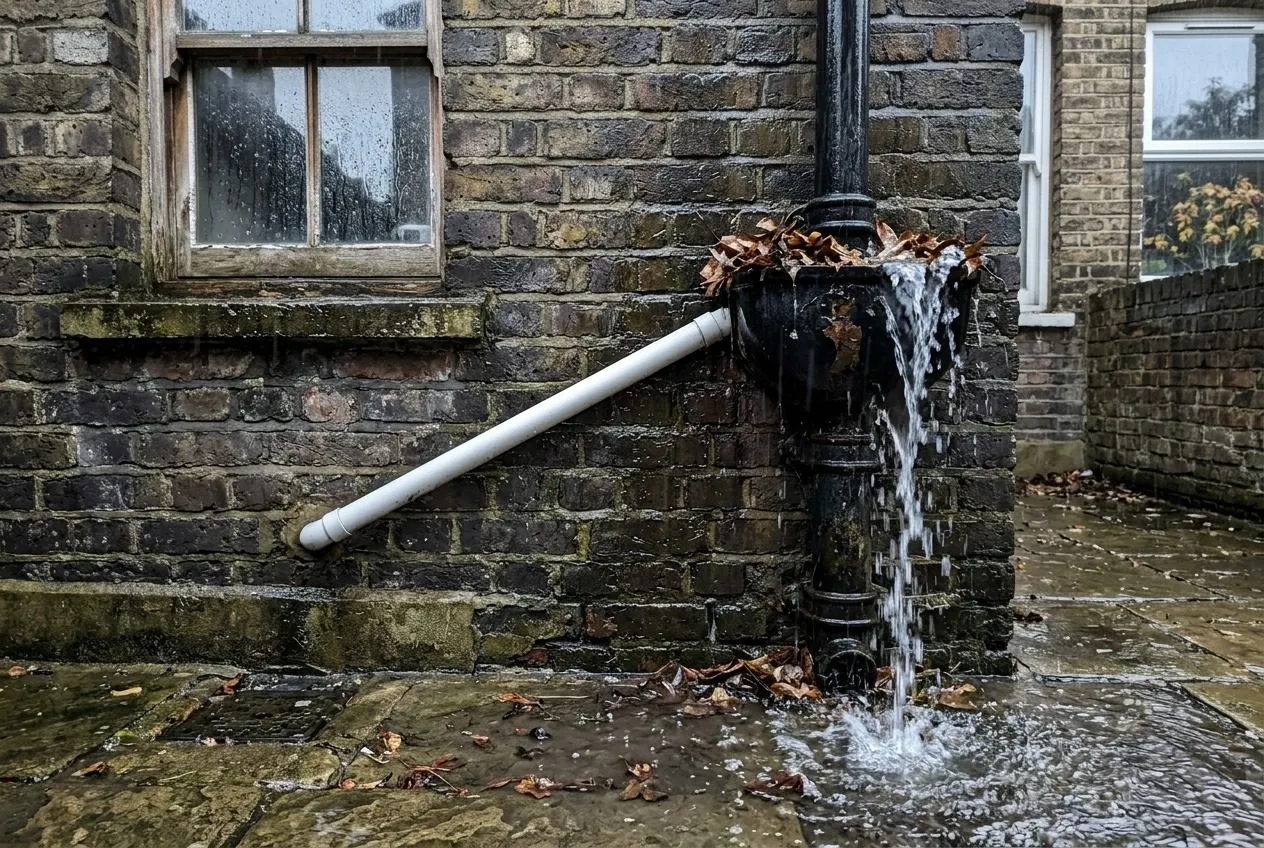
Illustration made with AI to show a condensate pipe feeding an overflowing downpipe. It is not a photo of one of our jobs.
What to check first (safely, from outside)
- Find the condensate pipe. Look on the outside wall near the boiler for a white plastic pipe, often with a lagged section. Follow it to where it ends.
- Look at what it runs into. A downpipe hopper full of leaves, a gully grate under a puddle, or a pipe that ends below ground level in a soggy flower bed are all usual suspects.
- Clear what you can reach from the ground. Scoop leaves off a gully grate or out of a low hopper with gloves on. Don’t climb ladders in the rain to do it. Seriously, it isn’t worth it.
- Give it time. If the drain is simply overwhelmed, it needs the rain to ease so the level drops below the end of the pipe.
- Reset once. Follow your boiler’s manual, or our guide on how to reset a boiler. If you get a fault code, our list of common boiler fault codes explains what most of them mean.
If the boiler fires and stays on, you’ve found your culprit. The rain will come back, though, so the pipe still wants looking at.
When it isn’t the condensate pipe
Rain gets blamed for a lot. A few other things line up with bad weather and are worth ruling out:
- Water coming in through the flue. In wind-driven rain, water can find its way in where the flue leaves the wall. It’s less common, but we’ve written a separate guide on rain coming through a boiler flue.
- Pressure dropping at the same time. If the gauge is falling below 1 bar as well, have a look at boiler losing pressure. That’s a different fault that can just happen to coincide with a wet week.
- A cold snap after the rain. A wet pipe that then freezes overnight gives the same lockout. Our winter plumbing checklist covers lagging and protecting it.
Who’s to blame, and who pays?
This one stings. In a case the Financial Ombudsman looked at, a homeowner claimed on his building insurance after water got into his boiler during heavy rain. The ombudsman sided with the insurer, finding there wasn’t enough evidence that a storm, rather than something like water held in the condensate pipe, caused the damage. Insurance isn’t something to rely on here, which is exactly why a ten-minute fix to the pipe run is worth doing before winter does it for you.
What we do when we come out
We’ll check the boiler’s fault history, clear any condensate trap that’s full of sludge, and follow the pipe all the way to where it ends. If it’s running into a downpipe without a break, or ending in a spot that floods, we re-route it, fit an air break, or both, and lag any section that’s outside. Then we fire the boiler and watch it run.
It’s charged at the same hourly rate whatever time you ring: no call-out charge, £110 for the first hour, £45 per half hour after, parts on top. You can see the full breakdown on our prices page.
If the house is cold, there are little ones or someone elderly at home, and the boiler won’t stay on, don’t sit it out till morning. Call or WhatsApp 07861 933265. Our emergency boiler breakdown engineers cover London and the M25 towns 24/7 and usually get there in 60 minutes. Or see everything our emergency plumber in London team handles.
Questions people ask
Why does my boiler only lock out when it rains?
Usually it's the condensate pipe. If it drains into a gully, a soakaway or a rainwater downpipe, a heavy downpour can fill that drain faster than it empties. The condensate then has nowhere to go, backs up into the boiler, and the boiler shuts itself down to stay safe.
Is it safe to keep pressing reset?
Press it once, after you've found and cleared the problem outside. If it locks out again straight away, or within a few minutes, stop. Hammering the reset button over and over doesn't fix anything, and some boilers will hold a hard lockout after too many tries.
Can I pour hot water on the condensate pipe like in winter?
That trick is for a pipe that has frozen. In rain the pipe isn't frozen, it's backed up, so warm water just adds to the flood. Clear the drain or downpipe it runs into instead.
Will my boiler warranty cover rain damage?
Don't count on it. Worcester Bosch has warned installers that water backing up into a boiler from a blocked or overflowing drain can void product guarantees. That's one more reason to get the pipe run sorted properly rather than living with it.
How much does it cost to sort out?
There's no call-out charge. It's £110 for the first hour and £45 for each half hour after that, plus any parts, at any hour of the day or night. Re-running a condensate pipe or fitting an air break is usually a short job.
Sources
- Heavy rain just as damaging as winter cold to condensing boilers, Worcester Bosch
- Ombudsman decision DRN-2300328: water entering a boiler during heavy rain, Financial Ombudsman Service