
Rain Coming Through Your Boiler Flue? What It Means
By Emergency Plumb,
It’s blowing a gale, the rain’s coming in sideways, and there’s a drip-drip-drip from the bottom of the boiler onto the washing basket. Next morning, dry as a bone. If that’s your house, the water is very likely coming in through the flue, and it only does it when the wind is pushing the rain straight at it.
Short answer: Rain should not get into a properly fitted, properly angled flue. When it does, it’s usually wind-driven rain hitting an exposed terminal, a flue that has dropped or was fitted at the wrong angle, or a joint seal that has perished. Switch the boiler off if water is dripping inside the case, catch the drips, and have the flue’s angle, seals and terminal checked. Fixing the cause is usually a small job; ignoring it can rot the boiler from the inside.
How rain gets in
A flue on a modern boiler is normally two pipes, one inside the other. The inner one takes the exhaust out; the outer one brings fresh air in. The whole thing is meant to fall gently back towards the boiler so the boiler’s own condensation runs back inside and away down the condensate pipe.
That design works fine in ordinary rain. Problems start when:
- The terminal is exposed. A flue on a gable end, a corner, or high up on a top-floor flat takes the full force of the weather. Gusts can drive rain into the air intake.
- The angle has gone wrong. If a flue has sagged, been knocked, or was fitted too steep, more water than it was designed for heads inside.
- A seal has perished. Rubber seals at joints and where the terminal meets the wall don’t last forever. Once one splits, water can track along the outside of the pipe into the wall and the boiler.
- Water’s arriving from above. A blocked gutter overflowing right over the terminal can dump far more water on it than rain ever would.
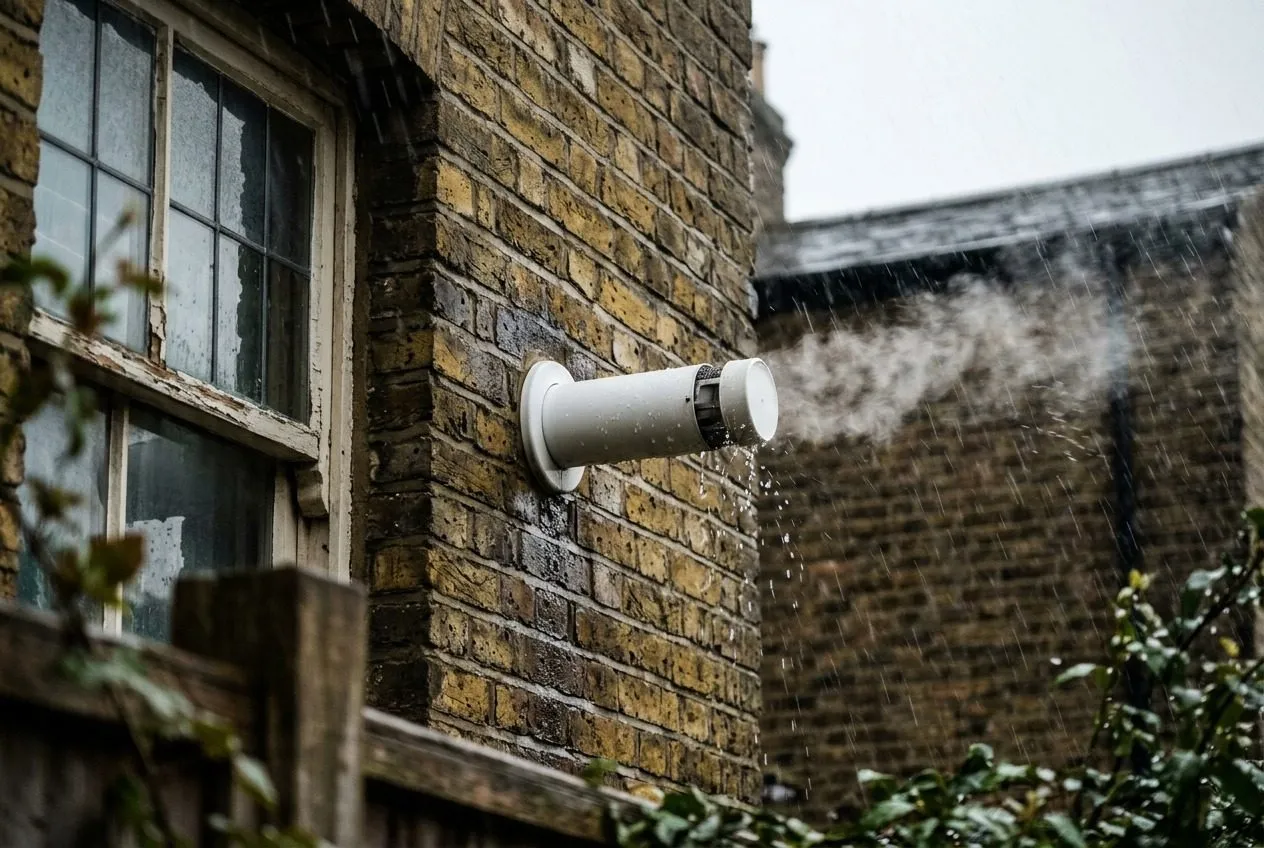
Illustration made with AI to show a flue terminal taking driving rain. It is not a photo of one of our jobs.
What an ombudsman said about it
Here’s a real one. A homeowner told his insurer that during torrential rain water overflowed the guttering and got into his boiler through the external flue. When the Financial Ombudsman looked at it, the ombudsman noted that a properly angled flue pipe shouldn’t normally let rain in, and that for it to happen, you’d usually need strong winds changing the direction of the rain or water pouring off a gutter. The claim wasn’t upheld.
Two takeaways. First, rain through a flue is a sign something about the flue or what’s above it isn’t right. Second, don’t assume insurance will pick up the bill. Get it fixed while it’s a seal or an angle, not a boiler.
Rain through the flue, or something else?
Before anyone starts replacing things, rule out the lookalikes:
| What you notice | Most likely |
|---|---|
| Drips only in windy, driving rain, dry otherwise | Water getting in through the flue |
| Boiler locks out in heavy rain but nothing drips | Condensate pipe backing up from a flooded drain. See boiler locking out in heavy rain |
| Drips whatever the weather, pressure keeps dropping | An internal leak. See boiler leaking water |
| Water running down the wall inside, not from the boiler | Gutter, roof or window, not the boiler at all |
What to do right now
- Switch the boiler off at its switch or fused spur if water is dripping from it. Don’t open the casing.
- Catch the water with a bowl or towels, and move anything electrical away.
- Take a quick video of the drip and the weather outside. It helps whoever comes out spot the pattern, and it’s handy if you ever do talk to an insurer.
- Look up from outside, from the ground. Is there a gutter right above the flue overflowing? Is the terminal sitting at an odd angle? Note it, don’t climb to it.
What the fix usually is
When we come out we check the flue’s fall back to the boiler, the joints, the seals and the wall plate, and look at what’s above it. Depending on what we find, that might mean resealing, resetting the flue to the right angle, fitting a guard or deflector approved for that boiler, or getting a gutter cleared so it stops pouring onto the terminal. We’ll also look inside for any corrosion the water has already caused, so you know where you stand.
It’s charged by the hour, same price day or night: no call-out fee, £110 for the first hour, £45 per half hour after, plus parts. Full details on our prices page.
If the boiler’s off, the house is getting cold and the weather’s not letting up, ring or WhatsApp 07861 933265. Our boiler breakdown team covers London and the M25 towns round the clock and usually arrives in 60 minutes. Need something else? Our 24-hour emergency plumbers deal with the lot.
Questions people ask
Should a boiler flue let any rain in at all?
It shouldn't, not in normal weather. A flue is set at a slight fall back towards the boiler so its own condensation drains away inside, and a properly fitted one is designed to keep weather out. If water is getting in, something about the angle, the seals or how exposed the terminal is needs looking at.
Is it dangerous to keep using the boiler?
Water inside the case isn't something to ignore. Turn the boiler off at the switch if water is dripping from the bottom of it or onto anything electrical, put a bowl underneath, and get it checked. Don't take the cover off yourself.
Why does it only happen when it's windy?
Straight-down rain mostly runs off. Rain blown sideways by strong gusts hits the terminal head-on and can be pushed in. That's why a flue on an exposed side wall or a top-floor flat suffers when a sheltered one round the back never does.
Will a flue cover or deflector stop it?
Sometimes the answer is a manufacturer-approved terminal guard or deflector, and sometimes it's resetting the flue to the right angle or replacing a perished seal. A cover bodged on to block the rain can stop the boiler breathing properly, so only fit parts made for your model.
How much will a call-out cost?
No call-out charge. £110 for the first hour, then £45 per half hour, parts extra, and it's the same at 3am on a Sunday as it is on a Tuesday afternoon.
Sources
- Ombudsman decision DRN-2300328: water entering a boiler through an external flue, Financial Ombudsman Service
- Heavy rain just as damaging as winter cold to condensing boilers, Worcester Bosch