
Hot Water in the Cold Water Tank in Your Loft?
By Emergency Plumb,
You go up to the loft for the Christmas decorations and it’s warm and damp up there, like a bathroom after a long shower. The cold water tank is steaming. Or you notice the bathroom cold tap is running hot, which makes no sense at all. It’s unsettling, and it should be taken seriously, but there’s a clear reason for it and some simple things you can do right now.
Short answer: Hot water ends up in a loft cold water tank when the hot water cylinder below overheats and pushes boiling water up its open vent pipe, which empties over the tank. The cause is nearly always a failed cylinder thermostat or immersion heater thermostat, or a boiler that keeps heating the cylinder when it shouldn’t. Switch the immersion heater off, turn the hot water off at the programmer, keep away from the tank, and get a plumber to find which control has failed.
How does hot water get into a cold tank?
Older London houses, especially Victorian and 1930s ones, often have a vented hot water system. There’s a copper cylinder in the airing cupboard, a cold water tank in the loft that feeds it, and a pipe called the open vent that runs from the top of the cylinder up into the loft and curls over the cold tank.
That vent is a safety route. If the cylinder ever gets dangerously hot, the expanding water has somewhere to go that isn’t a burst. So when you find warm or steaming water in the loft tank, the vent is doing its job, but it’s telling you something below has gone wrong.
There’s a second, gentler cause. If the cold feed and vent are badly arranged, hot water can circulate up the vent on its own, warming the tank slowly without any boiling. That gives a lukewarm tank rather than a steaming one, and it’s a pipework fix rather than an urgent one.
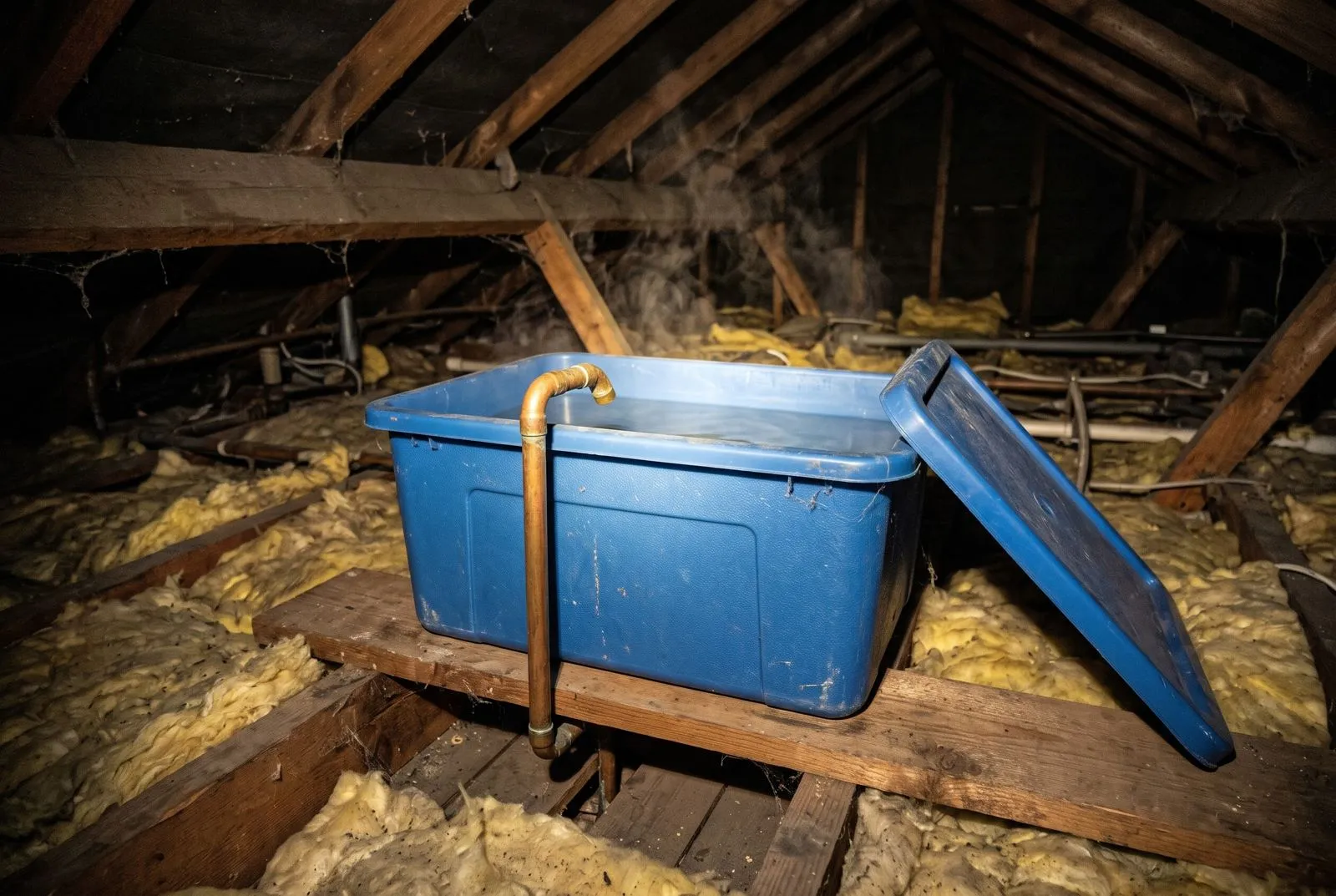
Illustration made with AI to show a steaming cold water tank in a loft. It is not a photo of one of our jobs.
What warning signs should I look for?
The Health and Safety Executive’s safety alert lists the signs that hot water storage has lost control of its temperature:
- water coming out of the hot taps far hotter than normal
- bubbling or loud noises from the cylinder
- hot water coming from some cold taps
- steam or moisture in the roof space
If you notice any of these, the HSE says to switch off the immersion heater and get a qualified plumber in. If you rent, tell your landlord the same day.
What to do right now
- Switch off the immersion heater at its switch, usually a red-lit switch near the airing cupboard.
- Turn the hot water off at the boiler programmer if your cylinder is also heated by a boiler.
- Stay out of the loft. The water in the tank and the vent pipe may be near boiling. Don’t lift the lid or put your hand in.
- Keep the cold mains on, so the loft tank keeps topping itself up and cooling down.
- Clear the rooms under the tank. The HSE notes that in the cases it investigated, a softened plastic tank that wasn’t fully supported gave way and hot water came through the ceiling. Keep children and pets out of those rooms until it has cooled.
If the cold taps are running warm but there’s no steam or noise, it may be the slower circulation problem. Our guide on why cold water runs warm covers the everyday reasons, like a tank in a hot summer loft.
What it usually is
| What you find | Likely cause |
|---|---|
| Steam in the loft, cylinder bubbling, immersion on | Immersion heater thermostat stuck on |
| Same, but only when the boiler heats the water | Cylinder thermostat or motorised valve stuck open |
| Hot water spitting out of the vent over the tank | Cylinder overheating, whichever heat source |
| Tank lukewarm, no noise, no steam | Hot water circulating up the vent by itself |
| Tank warm only in summer | Hot loft, not a fault |
How do we fix it?
We start by finding which heat source is running away. With the immersion off and the boiler on, and then the other way round, the cylinder tells us which one is to blame.
- Immersion heater. The thermostat is usually replaced, and the HSE recommends a type with a separate safety cut-out that works even if the thermostat fails. If the element is also tired or scaled, we change the whole heater. Our guide to an immersion heater not working explains how these parts work.
- Boiler side. A faulty cylinder thermostat or a zone valve that won’t close lets the boiler keep heating the cylinder. We test and replace whichever has failed, as part of a water heater repair.
- The loft tank itself. We check it’s sitting on a solid board across its whole base, not overhanging, and that the lid and vent are right. If it’s distorted or old, we replace it. Our cold water tank page covers that work.
It’s charged by the hour: no call-out fee, £110 for the first hour, £45 for each half hour after, plus parts. See our prices page for the details.
Steam in the loft right now?
Overheating water won’t wait until Monday. Our 24-hour emergency plumbers work across London and the M25 towns and usually reach you in 60 minutes. Turn the immersion and the hot water off, then call or WhatsApp 07861 933265. For the rest of what we do, visit our emergency plumber in London page.
Questions people ask
Why is there hot water in my loft tank?
On a vented system, the hot water cylinder has an open vent pipe that rises to the loft and bends over the cold water tank. If the cylinder gets far too hot, usually because a thermostat has failed, the water expands and boils and is pushed up that pipe and into the tank. It's a sign the heating side has lost control of the temperature.
Is it dangerous?
It can be. The Health and Safety Executive warns that an immersion heater with a failed thermostat can overheat the water in the cylinder, and links that to near-boiling water escaping through ceilings when a plastic loft tank has softened and given way. Switch the immersion heater off at once and get it checked.
What should I turn off first?
Turn the immersion heater off at its switch, and set the boiler's hot water to off on the programmer. Don't touch the tank or pipes in the loft, as they may be scalding. Leave the cold supply on so the tank keeps refilling, and keep people away from the rooms under the tank.
Why does a cold tap run hot?
In many older homes, some cold taps, often in the bathroom, are fed from the loft tank instead of the mains. If hot water is being pushed into that tank, those taps will run warm or even hot. The HSE lists hot water from cold taps as a warning sign to act on.
How much does it cost to fix?
No call-out charge. You pay £110 for the first hour, then £45 for each half hour, plus the cost of the thermostat, cut-out or valve, at any time of day or night.
Sources
- Scalding risk from domestic hot water systems - safety alert, Health and Safety Executive