Hot Water Goes Cold When the Washing Machine Fills?
By Emergency Plumb,
You’ve just got the shampoo in, the water’s lovely, and then somebody downstairs hits start on the washing machine. Ten seconds later you’re stood under a cold trickle, shouting down the stairs. It’s maddening, especially on a freezing November morning, but it’s one of the most common combi complaints we hear and it nearly always has a plain cause.
Short answer: A combi boiler heats mains water as it passes through, and it shares that mains pipe with everything else in the house. When the washing machine opens its cold fill valve, it takes a slice of the water the boiler was using, the flow through the boiler drops, and the shower runs cooler or the burner cuts out. Check your stopcock is fully open and test your flow with and without the machine running. If the flow collapses, the fix is usually on the supply side, not inside the boiler.
Why does a washing machine steal the hot water?
A combi has no tank of stored hot water. It switches on when water starts moving through it and raises the temperature of whatever flows past. Ideal Heating explains that a combi is designed to give a temperature rise that depends on the flow rate through the boiler, and that when more outlets are used, flow and temperature get shared between them.
A washing machine is just another outlet. Most UK machines fill from the cold supply only, and they fill in bursts, with a solenoid valve that snaps open and shut. Every time it opens, the cold main has to feed the machine as well as the boiler. Worcester Bosch describes this exactly: if the incoming main isn’t big enough, cold water gets “pinched” from the boiler when more than one outlet is used. The flow through your boiler drops, the boiler can’t keep a steady temperature, and on a weak supply it can fall below the minimum it needs to keep firing.
In older London terraces it’s often made worse by the pipe coming in from the street. Plenty of Victorian and Edwardian houses are still fed through a narrow, tired old supply, sometimes lead, that was never meant for a combi, a power shower and two appliances.
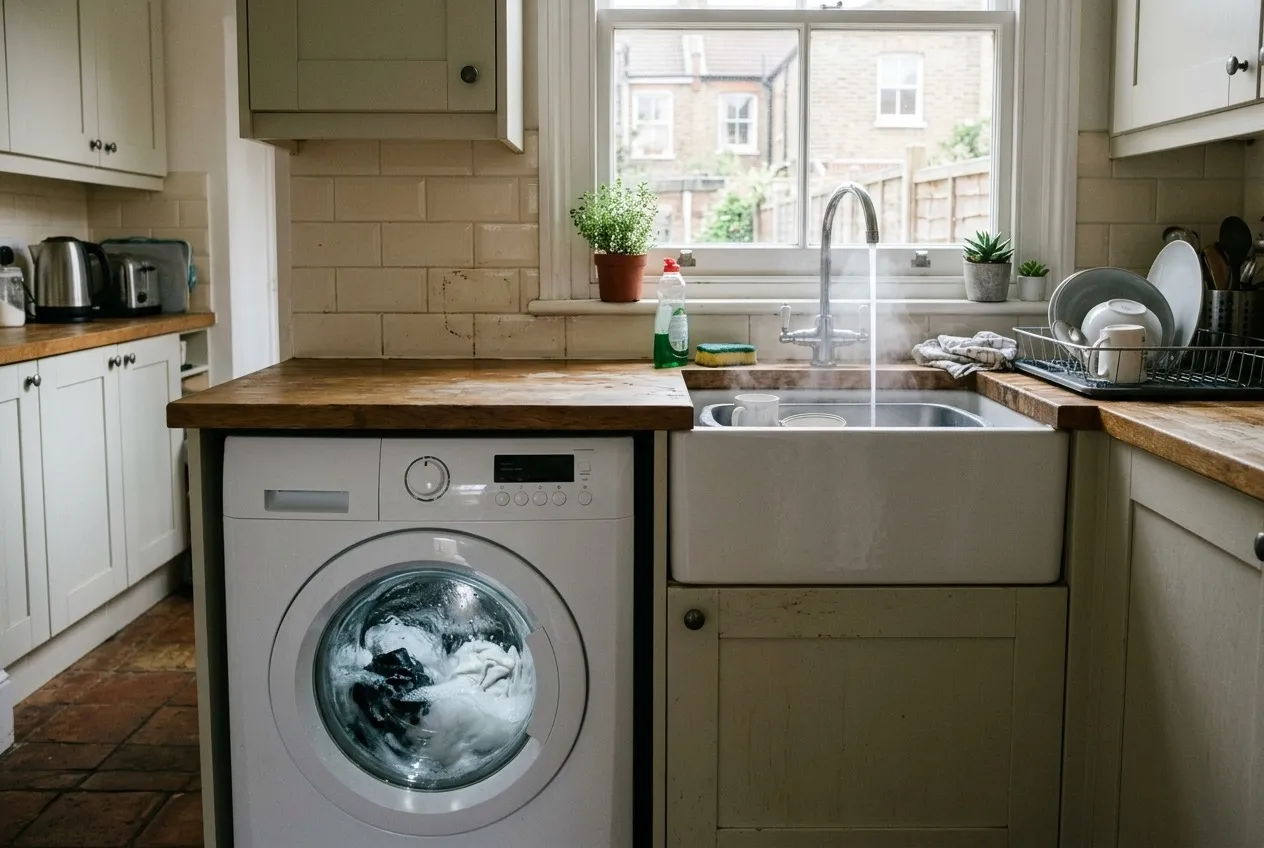
Illustration made with AI to show a washing machine filling while the hot tap runs. It is not a photo of one of our jobs.
How can I tell if it’s the supply or the boiler?
- Check the stopcock is fully open. It’s usually under the kitchen sink. Turn it anticlockwise until it stops, then back a touch. A stopcock left half shut after some old job is a classic cause. If it won’t budge, read our guide to a seized or stuck stopcock before you lean on it.
- Do a bucket test with nothing else running. Time how long the kitchen cold tap takes to fill a bucket. Write it down.
- Repeat it while the washing machine is filling. If the bucket takes a lot longer, your supply is struggling to serve two outlets at once.
- Try a hot tap on its own. If the hot is steady and properly hot with nothing else on, the boiler can do the job when it gets the water.
- Notice which outlets suffer. If only the shower goes cold, and the kitchen hot tap holds up, the shower valve or its cartridge may be part of the problem.
If the hot water is weak or lukewarm all the time, not just when the machine fills, that’s a different fault. Our guide to low hot water pressure when the cold is fine covers that one.
What it usually is
| What you notice | Most likely cause |
|---|---|
| Cold flow drops a lot when the machine fills | Small, old or partly closed incoming supply |
| Boiler cuts out completely, then relights | Flow dropping below the boiler’s minimum |
| Hot water weak even with nothing else running | Blocked inlet filter or scaled heat exchanger on the combi |
| Only the shower goes cold, taps stay hot | Shower mixer or cartridge struggling with the change in flow |
| Whole-house pressure poor all day | Supply problem, see our low water pressure guide |
How do we fix it for good?
We start with the boring, cheap things: the stopcock, any part-closed valves, and the filter on the boiler’s cold inlet, which can clog with grit and scale. Then we measure the flow you’re actually getting.
If the supply is the bottleneck, there are a few routes. Worcester Bosch suggests giving the boiler priority, for example by piping it up as the first thing off the incoming main, so appliances further along can’t starve it. Sometimes we re-run a section of undersized pipe. Where the old supply from the street is lead or very narrow, replacing it does the most good, and our lead pipe replacement page explains what that involves.
It’s all charged by the hour: no call-out fee, £110 for the first hour, £45 for each half hour after, plus parts, any day of the week. Everything’s set out on our prices page.
Cold house, no hot water at all?
If the boiler has stopped giving hot water entirely, or it’s locking out and won’t relight, that’s no longer a nuisance. Our 24-hour emergency plumbers cover London and the M25 towns, and we usually reach you in 60 minutes. Call or WhatsApp 07861 933265 and tell us what the boiler display says. For everything else we handle, have a look at our emergency plumber in London home page.
Questions people ask
Why does my shower go cold when the washing machine starts?
Most homes with a combi boiler run everything off one incoming mains pipe. A washing machine fills from the cold supply, and while it's drawing water, less reaches the boiler. A combi heats water as it flows through, so when that flow drops or wobbles, the temperature at your shower drops with it. If the flow falls far enough, the boiler can stop firing altogether.
Is my boiler broken?
Not usually. If the hot water is fine whenever nothing else is running, the boiler is probably doing its job and simply isn't getting enough water while the washing machine is filling. A worn flow sensor or a clogged inlet filter on the boiler can make it worse, so it's worth having those checked, but the supply is the first suspect.
Will a bigger combi boiler fix it?
Not on its own. A more powerful combi still needs enough water coming in. Worcester Bosch makes the point that the mains has to be big enough to feed the boiler while other cold outlets are open. If the incoming pipe is small, old or partly closed, a bigger boiler can actually make the problem more noticeable.
Can I stop it happening without any work?
As a stopgap, yes. Set the washing machine on a delay timer so it fills at night or while nobody is in the shower, and avoid running the dishwasher and a bath at the same time. It doesn't fix anything, but it keeps the peace in a busy house until the supply is sorted.
What does it cost to get it looked at?
We don't charge a call-out fee. You pay £110 for the first hour, then £45 for every extra half hour, with parts on top, and the rate is the same at three in the morning as at three in the afternoon.