
How to Bleed a Radiator, Step by Step
By Emergency Plumb,

Cold at the top, warm at the bottom means trapped air.
Short answer: Turn the heating off and let it cool, fit a bleed key to the valve at the top of the radiator, and open it a quarter turn until the hissing stops and water appears. Close it, then repressurise the boiler to 1.0-1.5 bar - bleeding removes water as well as air, and skipping that step causes a lockout.
Turn the heating off and let it cool
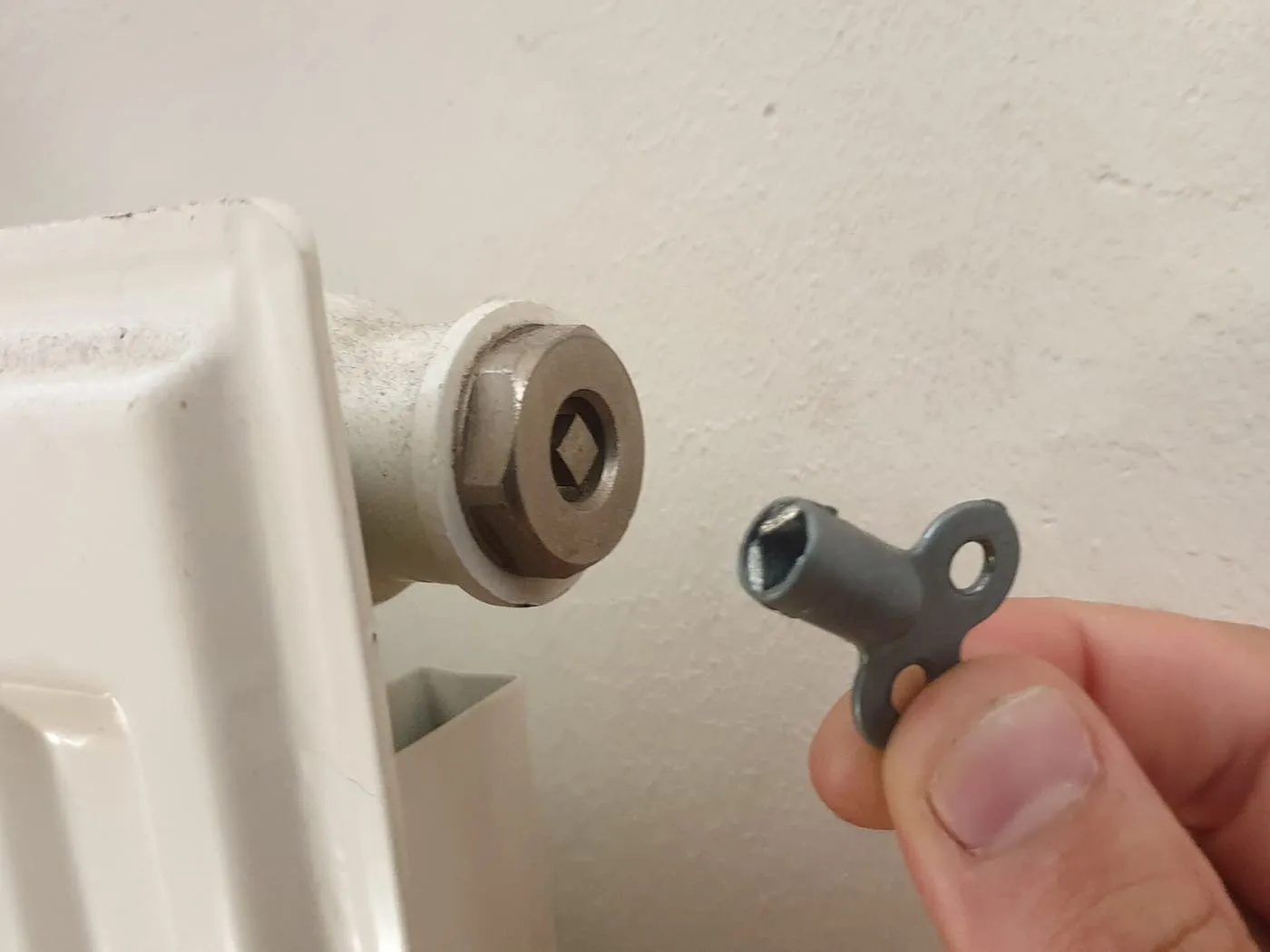
Bleeding a hot system is how people get scalded, and hot water under pressure will spit rather than trickle. Turn the heating off and give it twenty to thirty minutes. While it cools, find the bleed key, a small square key, available from any hardware shop for a pound or two, and a cloth and a small container.
Work out which radiators actually need it
Once the system has been on and then cooled, run your hand up each radiator. Cold at the top and warm at the bottom means trapped air, and that one needs bleeding. Cold at the bottom and warm at the top is the opposite problem, that is sludge, and bleeding will not touch it. Cold all over usually means a closed valve or a circulation fault rather than air.
Open the valve slowly
The bleed valve is the small square nipple at the top of one end of the radiator. Hold the cloth under it, fit the key, and turn anticlockwise about a quarter to half a turn. You should hear a steady hiss as air escapes. Do not open it further, a full turn can release the valve entirely, and then you are holding a jet of black heating water.
Close it the moment water appears
When the hissing stops and water dribbles out steadily rather than spitting, close the valve clockwise until snug. Do not overtighten; these are small brass fittings and they strip easily. Wipe the radiator down, heating water is full of magnetite and will stain a carpet permanently.
Repressurise the boiler afterwards, the step most guides skip
Bleeding removes water as well as air, so system pressure drops. Check the gauge on the boiler: it should read between 1.0 and 1.5 bar cold. If it has fallen below 1 bar, top up using the filling loop, the braided hose or lever valve underneath, opening it slowly until the needle reaches 1.5, then closing it fully. Skipping this is why people bleed their radiators and then find the boiler has locked out an hour later.
Work from the bottom of the house upwards
If you are doing the whole house, start with the ground floor and work up, and start furthest from the boiler on each floor. Air rises, so this order pushes it towards the highest points last rather than chasing it around the system. Re-check the pressure at the end rather than after every radiator.
Questions people ask
Do I bleed radiators with the heating on or off?
Off, and cool. Bleeding a hot system risks scalding, and water under pressure spits rather than trickles. Turn the heating off and give it twenty to thirty minutes before you start.
Which radiators need bleeding?
Run the system, let it cool, then feel each radiator. Cold at the top and warm at the bottom means trapped air and needs bleeding. Cold at the bottom and warm at the top is sludge, and bleeding will not help. Cold all over usually means a closed valve.
Do I need to top up the boiler after bleeding?
Yes, and this is the step most guides leave out. Bleeding releases water as well as air, so pressure drops. Check the gauge and top up via the filling loop to 1.0-1.5 bar cold, or the boiler may lock out within the hour.
What order should I bleed radiators in?
Ground floor first, working upwards, and furthest from the boiler on each floor. Air rises, so this pushes it towards the highest points last rather than chasing it around the system.