
Hot Water but No Heating? What to Check and in What Order
By Emergency Plumb,

The taps run hot but the radiators stay cold.
Short answer: Hot water but no heating means the boiler works but heat is not reaching the radiators. Check the thermostat, timer and boiler pressure first. On a combi, the usual fault is a stuck diverter valve; with a hot water cylinder, it is a zone valve or pump. Those repairs are for a heating engineer.
Why do I have hot water but no heating?
If your taps run hot but your radiators stay cold, the boiler is working, but heat is not being sent to the heating circuit. The most common causes are a thermostat or timer that is not asking for heat, low boiler pressure, a stuck diverter valve on a combi boiler, or a failed zone valve or pump on a system or regular boiler. Start with the controls, because they are the easiest to check and the most often overlooked. If you smell gas at any point, stop, open the windows, do not use light switches, and call the National Gas Emergency line on 0800 111 999.
Combi, system or regular: which boiler do you have?
The cause depends on your boiler type, so work that out first. A combi boiler heats water instantly as you use it and has no hot water cylinder, the large tank usually kept in an airing cupboard. A system boiler has a cylinder but no tank in the loft. A regular boiler, sometimes called conventional or heat-only, has a cylinder and a cold water tank in the loft as well. If you have a combi, the likely suspect later on is the diverter valve. If you have a cylinder, look at the zone valves and the pump. Either way, do the checks in the next three sections first.
Check the thermostat and the timer first
This sounds too simple, but it catches a lot of people out, especially at the start of autumn. Turn the room thermostat up well above the current room temperature and listen for a click or watch for the boiler to fire. Check the timer or programmer is set to heating on, not hot water only, and that the clock shows the right time, since power cuts and clock changes often knock it out. If your thermostat is wireless, change its batteries. Smart thermostats can lose their connection to the receiver near the boiler, so check the app for an offline warning. Some boilers also have a separate heating temperature dial; make sure it has not been turned right down.
Check the boiler pressure
Look at the pressure gauge on the front of the boiler. On most sealed systems it should read between 1 and 1.5 bar when the heating is cold. If it has dropped below about 1 bar, the boiler may refuse to run the heating, and on many models it shows a fault code. Topping up through the filling loop is safe to do yourself if the boiler manual explains it. If the pressure keeps falling after you top it up, there is a leak somewhere in the system, and that needs finding rather than repeated topping up.
Air in the radiators and stuck radiator valves
If some radiators are warm and others are cold, the problem is probably in those radiators rather than the boiler. Cold at the top means trapped air, and our guide to bleeding a radiator explains how to let it out. Also check the thermostatic radiator valves, the numbered dials on the side of each radiator. The small pin underneath the head can stick in the closed position, especially after a summer of not moving. Turn the dial to maximum, unscrew the head, and gently tap or wiggle the pin with the handle of a screwdriver until it moves in and out freely. That is safe to do and often brings a radiator straight back.
Combi boilers: the diverter valve
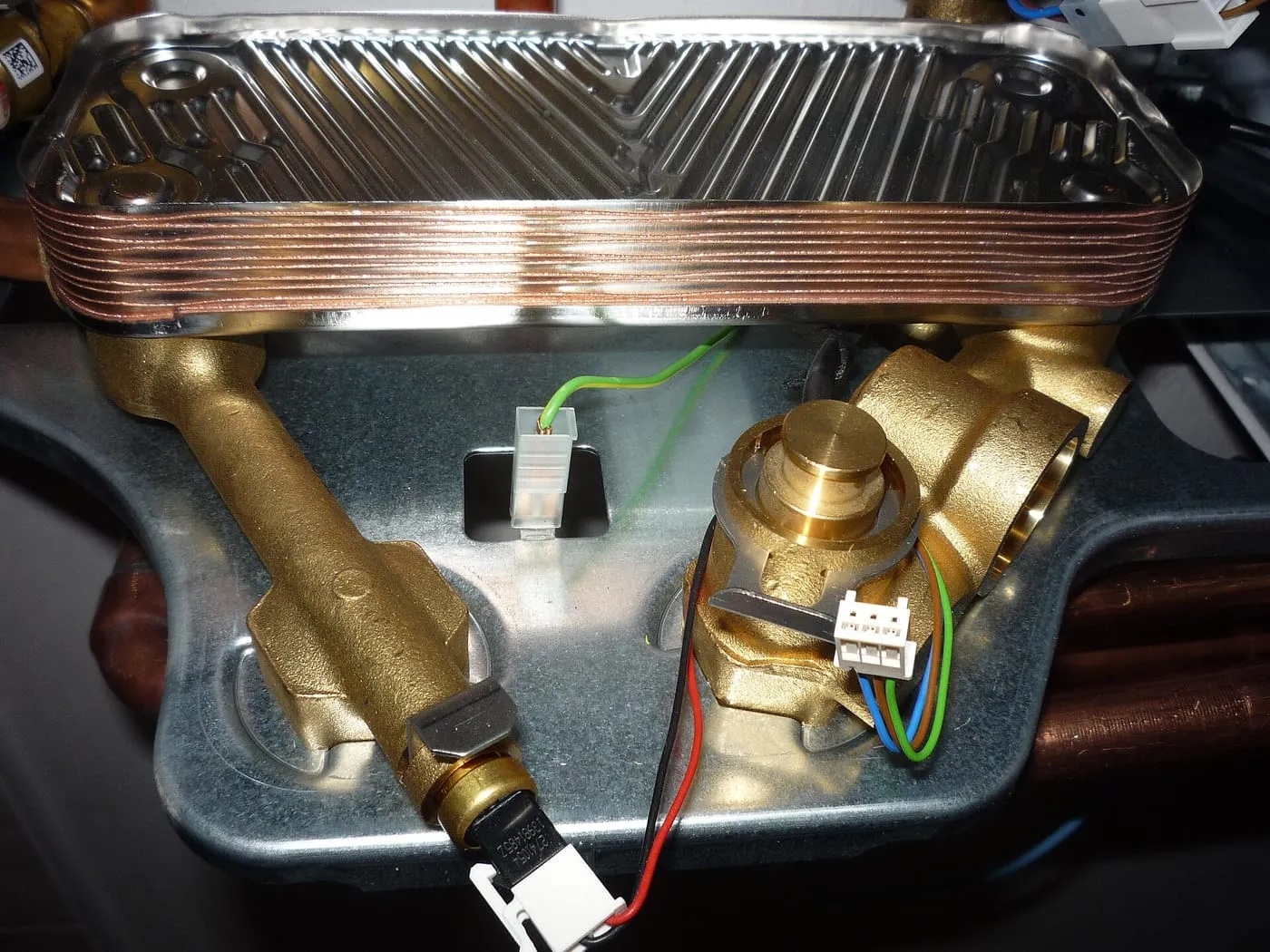
Inside a combi boiler, the diverter valve decides whether hot water goes to the taps or to the radiators. When it sticks in the hot water position, you get exactly this problem: hot taps, cold radiators. Sometimes the radiators warm up only while a hot tap is running, which is another tell-tale sign. There is nothing safe for you to do here. The valve is inside the boiler casing, and that cover should only come off in the hands of a trained boiler engineer. It is a common and well-understood repair.
System and regular boilers: the zone valve and the pump
With a cylinder, a motorised valve sends heated water either to the cylinder or to the radiators. Some homes have one three-port valve doing both jobs, others have two separate two-port valves. If the heating side sticks shut or its motor head fails, the boiler still heats the cylinder but the radiators get nothing. You can often find the valve near the cylinder and see a manual lever on its head, but diagnosing it properly involves wiring, so leave it to an engineer. The pump is the other suspect. It pushes water around the radiators, and in some older homes the hot water cylinder heats without the pump’s help. A pump that has seized can hum, feel very hot, or be silent. Do not try to free it yourself, because it sits on live wiring and hot pipes.
What to leave to a boiler engineer
Thermostats, timers, batteries, the pressure gauge, bleeding radiators and freeing a sticky radiator valve are all safe for you to do. Anything behind the boiler casing, the diverter valve, the zone valve wiring and the pump are a job for an engineer. A gas appliance is not something to take apart yourself, so for anything inside the boiler book a heating engineer. We do not work on boilers, but if the fault turns out to be a leaking radiator or the heating pipework, we can help with that.
Questions people ask
Why is my central heating not working but hot water is?
The boiler is heating water but not sending it to the radiators. Check the thermostat is set above room temperature, the timer is on heating, and the pressure is about 1 to 1.5 bar. If those are fine, it is usually the diverter valve on a combi or a zone valve or pump on a system boiler.
Can I fix a diverter valve myself?
No. The diverter valve is inside the boiler casing, and opening a gas boiler is a job for a boiler engineer, not a homeowner.
Can low boiler pressure stop the heating?
Yes. Below about 1 bar, many boilers stop running the heating and show a fault code. You can usually top up through the filling loop using the boiler manual. If the pressure keeps dropping, there is a leak that needs finding.
Why are some radiators hot and others cold?
That points to the radiators, not the boiler. Cold at the top means trapped air, which bleeding fixes. A radiator that stays cold all over often has a thermostatic valve pin stuck shut, which you can free by removing the head and gently moving the pin.
What does a zone valve do?
On a system or regular boiler, a motorised zone valve sends heated water either to the hot water cylinder or to the radiators. If the heating side sticks shut or its motor fails, you get hot water but cold radiators. Diagnosing it involves wiring, so it is an engineer's job.