
Boiler Pressure Rises When You Use Hot Water? Here's Why
By Emergency Plumb,
You topped the boiler up last month, set it nicely at 1.5, and now every time someone has a bath the needle wanders towards the red. Or you come down in the morning and it’s sitting at 2.5 when you swear nobody touched it. It feels like the boiler has a mind of its own. It hasn’t. Water is getting in from somewhere, and when the rise is tied to hot water or to quiet nights, the list of suspects is short.
Short answer: If the pressure only climbs while hot water is running, or creeps up overnight, mains water is leaking into the sealed heating circuit. The two usual routes are a filling loop valve that isn’t shutting off fully and a plate heat exchanger inside a combi that has started to pass. Disconnect the filling loop if it’s a braided hose, bring the pressure back down, and watch it. If it still climbs with the loop off and only when the hot taps run, the heat exchanger is the likely culprit.
This guide is about pressure that rises with hot water use or on its own. For the general fixes when the gauge is simply too high, start with our guide to boiler pressure too high.
Some rise is normal, so how much is too much?
Heating water expands as it warms, so the needle moving a little when the radiators are on is expected. Viessmann says most boilers run at about 1 to 1.5 bar, and that on a combi the pressure should generally not go up by more than 0.5 to 1 bar when there’s demand on the system. A rise of more than 1 bar once the heating is up to temperature could point to a fault, typically with the expansion vessel.
The pattern in this guide is different. With the heating off and the system cold, the pressure goes up when someone runs a hot tap or showers, or it drifts up overnight. That isn’t expansion. That’s extra water.
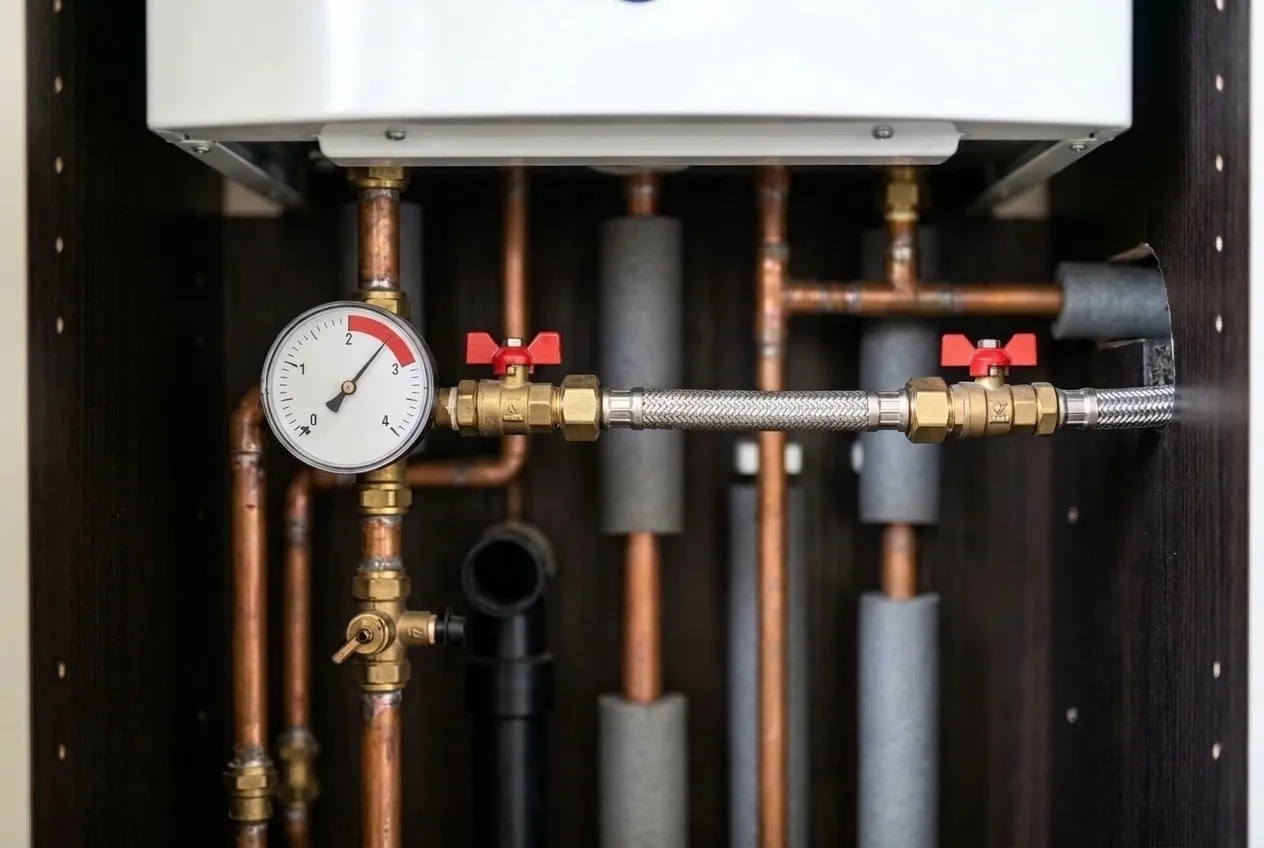
Illustration made with AI to show a filling loop and a pressure gauge under a combi boiler. It is not a photo of one of our jobs.
Where’s the extra water coming from?
A filling loop letting by. The filling loop is the link between the mains and your heating, usually a silver braided hose with a valve at each end, or a built-in lever or key under the boiler. Viessmann’s own advice for a rising gauge is to check you haven’t left the valve or filling loop open. Even when both handles look closed, a worn valve can let a slow trickle through. Because mains pressure is usually higher than the heating side, water seeps in until something gives.
Why the neighbours make it worse. Mains pressure isn’t fixed. When the whole street is running baths at seven in the evening it drops, and at three in the morning it climbs. So a valve that’s letting by pushes in more water overnight, which is why the gauge often looks worst first thing.
A passing plate heat exchanger. Inside a combi, a plate heat exchanger warms your tap water using the heating water, with thin plates keeping the two apart. If a plate fails, mains water at higher pressure gets pushed across into the heating every time hot water runs. The tell-tale sign is that the pressure jumps while a hot tap is open, even with the filling loop disconnected.
How to narrow it down
- Turn the heating off and let it cool. Note the pressure on the gauge.
- Check the filling loop handles are fully closed, at a right angle to the pipe on most valves.
- Disconnect a braided loop if you have one. Unscrew it by hand at one end with a towel underneath. If water keeps dribbling from the valve on the mains side, that valve is letting by. Many filling loop guides say the hose should come off after every top-up anyway, because leaving it connected risks heating water flowing back into the mains.
- Bring the pressure back down by bleeding a radiator a little at a time, as our too-high pressure guide explains.
- Run a hot tap for a few minutes and watch the gauge. If it climbs with the loop disconnected, suspect the plate heat exchanger.
- Check outside for drips. A copper pipe from the boiler through the wall that’s dripping or has left a stain means the relief valve has been opening.
What it usually is
| What you see | Most likely cause |
|---|---|
| Rises overnight, worst in the morning | Filling loop valve letting by |
| Water drips from the loop valve when the hose is removed | Worn filling loop valve |
| Rises only while a hot tap is running, loop disconnected | Passing plate heat exchanger |
| Rises a lot only when the heating is hot | Expansion vessel lost its charge |
| Rises then suddenly falls, pipe outside dripping | Relief valve opening, and possibly now letting by itself |
If the gauge is going the other way and keeps dropping, that’s a separate fault with its own guide: boiler losing pressure.
What does the repair involve?
A filling loop valve is a small, quick job: isolate it, swap the valve, refill to the right pressure, and leave the hose off. If we find the relief valve has been opening a lot, we check it hasn’t started to drip on its own and replace it if it has. A plate heat exchanger is a bigger job inside the boiler, so we confirm it properly before suggesting it, and we’ll talk you through whether it’s worth doing on an older boiler.
You pay for the time we’re there and the parts, nothing more: £110 covers the first hour, £45 each half hour after, and there’s no call-out fee, nights and weekends included. See our prices page for how it adds up. We cover central heating repair across London.
Water pouring from the pipe outside?
If the relief valve is gushing, the boiler has locked out, or the pressure won’t come down at all, give us a ring. Our 24-hour emergency plumbers are out across London and the M25 towns and usually with you in 60 minutes. Call or WhatsApp 07861 933265, or see how our emergency plumber in London service works.
Questions people ask
Why does my boiler pressure go up when I run a hot tap?
On a combi, the heating water and your tap water are kept apart inside the boiler. When the pressure climbs only while hot water is running, the usual reason is that mains water is finding its way into the heating side, either through a filling loop valve that doesn't shut off fully or through a leak inside the plate heat exchanger.
My pressure rises overnight when nobody is using water. Is that the same thing?
Very likely, yes. Mains pressure in the street tends to be higher when everyone is asleep and demand is low, so a filling loop valve that's letting by pushes more water in at night. If you see the needle higher every morning and lower after you bleed a radiator, the filling loop is the first thing to check.
Is it dangerous?
It isn't going to explode. The pressure relief valve will open and dump water through a pipe outside before it gets that far. But a valve that keeps opening can start to drip permanently, and the repeated high pressure is hard on seals and joints, so it's worth sorting rather than bleeding radiators every few days.
Should the filling loop stay connected?
No. A braided filling loop is meant as a temporary link between the mains and the heating. Guidance on filling loops says they should be disconnected after use to keep within water regulations, because heating water mustn't be able to flow back into the mains. Disconnecting it also stops a worn valve from slowly overfilling the system.
How much will it cost to fix?
There's no call-out charge. It's £110 for the first hour and £45 for each half hour after that, plus the cost of any parts. A filling loop valve is a quick swap; a plate heat exchanger takes longer and the part costs more.
Sources
- How to increase boiler pressure, Viessmann
- What is a boiler filling loop?, iHeat